
Late diagnosed at 39.
Everything clicked.
I'm a late-diagnosed autistic coach, community builder, and the person who turned 600+ TikTok comments into a food systems guide. I help neurodivergent adults build lives that actually work for their brains.
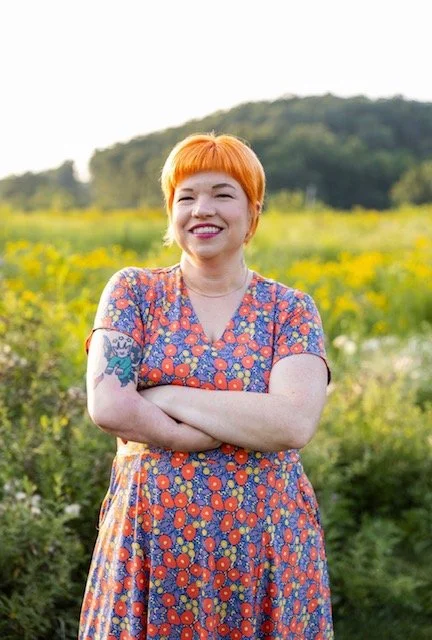
"My work is community-sourced, shame-free, and built entirely around your needs — not neurotypical expectations."
My Story
01
I was 39 when I found out I was autistic.
It wasn't a dramatic moment. It wasn't a doctor sitting me down with a clipboard. It was more like reading a list of things I'd spent my whole life thinking were just personal failures and realizing, for the first time, that they had a name.
Sensory overload. Executive dysfunction. The way social situations drain me in ways I can never quite explain. The deep, exhausting work of appearing fine when I'm not. All of it suddenly made sense in a way it never had before.
"It felt like someone had finally handed me the instruction manual for my own brain. Thirty-nine years late, but still."
And honestly? My first feeling wasn't relief. It was grief. Grief for the younger version of me who had no idea why things felt so hard, who just assumed she wasn't trying hard enough.
02
Before I knew, I was just surviving.
I spent most of my adult life building elaborate systems to appear functional. I masked constantly. In social situations, at work, in relationships. I overextended myself trying to meet standards that weren't built for a brain like mine, and then crashed hard when I couldn't keep up.
I didn't know I was autistic. I just knew that everything felt harder than it seemed to for other people. I thought I was anxious, or disorganized, or…..honestly…….just not cut out for the things everyone else seemed to manage just fine.
I have a social science research background and a master's degree. I'm educated. I'd read plenty. And still, the idea that I might be autistic had never really landed. That's how good the masking was. That's how completely I'd internalized the idea that my struggles were a me problem and not a mismatch between my neurology and the world.
03
Then everything clicked.
When I got my diagnosis, I didn't just learn something new about myself. I started seeing my entire life differently. The things I'd always been ashamed of started looking less like failures and more like adaptations. The systems I'd quietly built to survive started looking like strengths.
I started unmasking, slowly, carefully, in the spaces where it felt safe. I started letting go of the neurotypical standards I'd been holding myself to. I stopped trying to be consistent and started focusing on sustainable. I stopped apologizing for the way my brain works and started designing my life around it instead.
"Unmasking isn't one moment. It's a thousand small decisions to stop pretending and start accommodating yourself instead."
It was (and still is) the most important work I've ever done. And I knew pretty quickly that I wanted to help other people do it too.
04
How I became a coach.
I didn't set out to build a coaching practice. It grew out of community. I'd been sharing openly about my own experience. The late diagnosis, the unmasking process, the practical systems I was building. People kept reaching out to say it resonated.
One of my earliest coaching clients was struggling with something that was completely outside my own experience: feeding herself regularly. Executive dysfunction, sensory issues, low spoon days, the whole picture. I wanted to help, but I didn't have enough of my own knowledge to draw from.
So I did what I always do. I went to the community. I made a post on TikTok asking for strategies from people with lived experience. I was hoping for maybe 50 responses. I got over 600.
That post became the Food Systems guide. And the Food Systems guide taught me something I've carried into every part of my work since: the autistic community already has the answers. My job is to collect them, organize them, and make them accessible.
Now I run a coaching practice, create resources, speak and facilitate workshops, and host the Spicy Brain Collective, a Pittsburgh community for autistic adults to connect and unmask in person. All of it is built on the same foundation: community wisdom, zero shame, and practical tools that actually work for neurodivergent brains.
03
My kids taught me as much as I taught them.
Both of my kids are autistic. Watching them navigate a world that wasn't built for them, and learning how to advocate for them, accommodate them, and support them without inadvertently pushing neurotypical expectations onto them. It has shaped my approach to coaching more than anything else.
It was actually through my oldest kid that I had one of my biggest food systems breakthroughs. I kept trying to get him to eat in the kitchen. He kept eating in his room. I lectured him about it. Nothing changed.
And then I read my own guide and realized I was enforcing a food rule that had nothing to do with his actual needs. He needed food to be accessible wherever he was. So I bought a bigger trash can and turned a cart into a bedroom snack station. He eventually started using the kitchen more, but more importantly, I let go of a rule that was causing friction and shame for no real reason.
"Parenting autistic kids while being autistic yourself means you're constantly learning the same lessons you're trying to teach."
That's true of everything I do. I'm not someone who figured it all out and is now passing down wisdom from a distance. I'm in it with you, still unmasking, still adjusting my systems, still learning what it means to build a life that actually fits.
My coaching philosophy.
These aren't values I put on a website. They're things I built my practice around because I needed them myself first.
01
Community wisdom over clinical advice
Consistency is a neurotypical metric. Autistic brains have fluctuating capacity. That's not a flaw, it's a fact. My work is built around sustainability: systems that hold up through the hard weeks, not just the good ones.
03
Zero tolerance for shame
Most of what autistic adults feel shame about is a mismatch between their neurology and a world built for someone else. I work from the assumption that you are not broken. You are accommodating an unaccommodating world.
04
You are the expert on yourself
I don't hand you a system and tell you to follow it. I help you understand your own patterns well enough to build something that actually fits, because no two spicy brains work the same way.
02
Sustainable over consistent
Consistency is a neurotypical metric. Autistic brains have fluctuating capacity. That's not a flaw, it's a fact. My work is built around sustainability: systems that hold up through the hard weeks, not just the good ones.
05
Sustainable over consistent
Feeling seen is important. But it's not enough on its own. My work is designed to give you something you can actually use Worksheets, frameworks, strategies, and systems you can reach for when everything is hard.
06
Sustainable over consistent
I built the Spicy Brain Collective because isolation is one of the hardest parts of being a late-diagnosed autistic adult. Connection with people who actually get it isn't a nice-to-have. For a lot of us it's essential.
"You've done the hard part of figuring out who you are. Now let's build a life that actually fits."
My work isn't about fixing you or making you more neurotypical. It's about helping you design a life around the brain you actually have, with the tools, community, and zero shame you deserve.
Pittsburg community
The Spicy Brain Collective
A local space for autistic adults to connect, unmask, and build real friendships, without the social scripts.
Learn More
Work with me
1:1 Autistic Integration Coaching
Design a life that works for your brain. We work on self-advocacy, nervous system regulation, and practical systems together.
Resources
Food Systems
The food systems bundle, built from 600+ community voices. Practical strategies for every kind of spoon day, starting at $4.99.